The Liberal Arts Are the Skills Habits and Values of Entrepreneurship
The Ten Best Tips from the "Classroom to Career" Alumni Panel
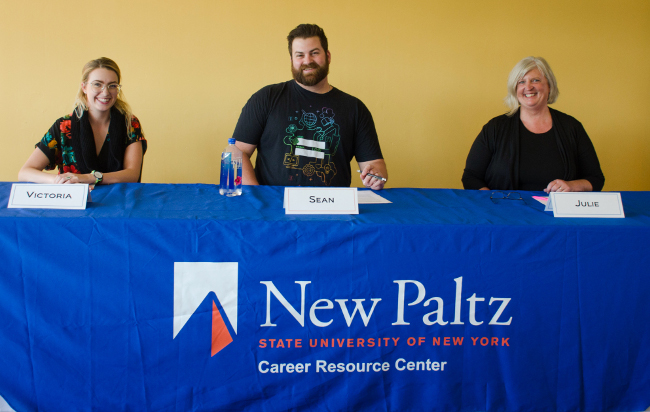
If you desire advice on how to navigate today'south tough job market and find rewarding careers, listen to the personal stories of 3 inspiring alumni from the Higher of Liberal Arts & Sciences.
The Career Resources Middle and the Higher of Liberal Arts & Sciences hosted its third almanac "Classroom to Career: The Value of a Liberal Arts Caste" on October 12 in the College Terrace. The event brings alumni from dissimilar disciplines back to campus each fall to share their wisdom with undergraduates.
Here are 10 great tips from this yr's panelists.
1. Recognize the Skills You've Gained Pursuing a Liberal Arts Degree
As a liberal arts major, information technology's important to recognize the many valuable skills you're acquiring and be able to clear those skills to future employers.
Julie Robbins '95 (Economic science) co-founded the co-working space I Epic Identify in New Paltz. Robbins works with entrepreneurs daily and credits her liberal arts degree with developing her interpersonal skills, enabling her to juggle multiple priorities and call up on her feet. "I think that is the dazzler of a liberal arts degree," she said. "You lot go a more than diverse degree. You lot're non pigeon-holed into one thing."
ii. When Interviewing, Be Yourself
Every bit the Assistant Manager of Development for Alumni at Bard Higher, Victoria Morrell '13 (History, Religious Studies) relies on her first-class communication skills daily. Simply she recently realized that she didn't always present herself well in interviews.
"I wished that someone had saturday me down and said, 'You don't have to put on your grownup voice; you simply need to be yourself.' Employers want to know y'all're an authentic person and accept thoughts and beliefs," she said.
At her interview at Bard a year agone, Morrell chatted about yoga prior to her interview, which fabricated her seem less similar an overly broken-hearted young professional focused on maxim all the right things and more like an interesting potential co-worker.
"These people who you're interviewing with are going to become your colleagues later on if you get that position, and some of them are going to be your friends, so when you into an interview, don't remember of it as 'This person'due south here to judge me," only think of it as 'I'grand about to run into a new friend,'" she brash.
3. Make up one's mind if Graduate School is Right for You
Graduate School tin exist a rewarding educational experience that allows you lot to deepen your knowledge of an surface area of great personal interest and help you advance in your career. But requite serious consideration to your educational and career goals before taking the jump.
Sean Haberkorn '11 (Journalism, Public Relations concentration) worked a few jobs before discovering his passion as the Manager of Customer Relations at Indeed.com. He decided to forgo graduate schoolhouse and instead focus on building his career. "Once I was able to sit downward and place, 'I want to grow with this visitor, I focused on doing but that," he said.
4. Embrace Your Own Path
In life, expect the unexpected. Robbins planned to pursue a Ph.D. in ecology economic science when a "surprise infant" halted her plans. Instead of pursuing a Ph.D., she founded her ain businesses and discovered a passion for helping fellow entrepreneurs.
"Every route you have in life is worth something," Robbins noted. "Just because you didn't get down this one road you idea you were going to get downward, embrace the road y'all did become down," she said.
Part of that journey is defining your own version of success, noted Robbins, who advised students to always follow their interests and passions.
5. Cultivate Your Passions
Unsure of what your passions are? Examining your habits and preferences volition give you valuable clues.
Initially a journalism major, Morrel discovered that her desire to constantly express her opinions might not make her the most impartial reporter. In contemplating a alter in major, she considered what classes fabricated her excited to get out of bed in the morning and what television programs she tuned into most. Recognizing that she enjoyed dissecting texts and preferred historical documentaries to Keeping Upwards with the Kardashians, she opted to study history instead.
"Realize that everything you do on a daily basis informs what your passions are," Morrell noted. "What makes you lot a person is what y'all're passionate most—you just have to dissect information technology and retrieve virtually information technology a little more than."
Robbins likened the process to stretching a muscle. "Just start to detect each day the things that brand you really happy or become y'all excited," she said.
vi. Grow Your Network
Though networking might make you think of bad-mannered conversations at cocktail parties, you demand not be agape. Talking to people can assist you expand your professional network and lead to jobs and other valuable experiences.
Haberkorn credits his career success with forging proficient relationships at every job and internship he had. While working function-time at Gourmet Pizza in New Paltz, Haberkorn reconnected with a coworker from his first job who worked for Indeed.com and gave him his concern bill of fare. "If I didn't keep in touch on with that person from my offset role, if I wasn't always keeping in contact with people when I left a task and didn't burn any bridge, and kept those positive connections, I wouldn't be where I am today," he said.
vii. Exercise Your Research
The enquiry skills you lot gain in your major will be invaluable for your interview preparations.
As a hiring manager, Haberkorn doesn't look for candidates with particular degrees. He looks for people who are passionate, genuinely interested in the visitor, and most chiefly, prepared. "I always ask, 'What exercise you know about Indeed? What do you know about this role?' Because I want to come across you did the research and understand the visitor, empathise what yous're doing. If you tin can't do the training for the interview, you probably won't be able to do the grooming that goes into the piece of work," he said.
eight. Be Confident
Whether you're an introvert or an extravert, project confidence when searching for a job.
Robbins said confidence is "easily-downward" the most of import quality she looks for when hiring. "When a confident person walks in the room, you feel information technology right away," she said. "There has to exist practiced communication skills, eye contact."
Identifying preparedness every bit the cardinal to confidence, Haberkorn stressed the importance of existence well informed and prepared for potential interview questions. "You could be a quiet person and still show that y'all're super passionate well-nigh something. I just want to see that y'all're engaged," he said. "When you're interviewing, exist yourself, be confident, be passionate and be prepared to speak to why you should be in that role."
9. Take Advantage of Opportunities
Equally a New Paltz educatee, a wealth of opportunities are available to you to explore potential careers.
Morrell stressed the value of conducting informational interviews with alumni and professionals in careers of interest and visiting the Career Resource Center and Alumni Affairs Office for more resources. "These services exist even after you lot graduate," she said. "They want to hear from you."
10. Breathe
If thinking about your future makes yous hyperventilate, remember to breathe.
"If you don't know where you want to go after college, information technology'southward okay," said Haberkorn, who advised students to say yeah to opportunities but never settle. "You need a job afterward school. It'due south okay if it's not what you want to do for the residual of your life, because you'll become there," he said, recounting his own experiences of finding the correct career fit.
"Go on trying until you get to somewhere where you're truly happy, where you actually like what you lot're doing. It doesn't have to exist the first stride in the route; you'll go there," he said.
--
For information most resume writing, interview skills and other career-related information, visit the Career Resource Center or contact the LA&Due south career specialist Emily Zurner.
Women's Summit Alumnae Share Secrets of Success
7 years into her broadcasting career, Sapna (Sklyer) Srivastava '04 (Journalism) had an "Aha moment." Afterwards winning three radio awards, Srivastava began to encounter herself not every bit a struggling young journalist, only a capable professional who learned from her mistakes and caused the skills she needed to succeed. Her self-confidence bolstered by the industry recognition, Srivastava thought, "I might be adept at this."
Having organized religion in ane's ability to acquire and grow was a primal message of the March 1 Women'southward Leadership Acme, which brought alumnae and thought leaders to campus to share professional person advice, reply student questions and empower the next generation of New Paltz graduates.

Srivastava, now a news ballast for NBC 2, joined fellow alumnae Luz Avila-Kyncl '96 (Psychology), Jessica Gardner '00 (Journalism) and Debbie Lesperance '96 (Black Studies) at an afternoon breakout session for College of Liberal Arts & Sciences students. Nancy Johnson, a professor of English, co-moderated the event with Hannah Phillips, a student in the English language master's program.
Gardner, a onetime journalist for the Times Herald-Record, honed her marketing skills at three Hudson Valley companies before founding her own full-service marketing firm, Media Solstice Marketing and PR. Gardner championed the value of a strong work ethic and advised students to strive for continuous self-comeback. "Don't focus on what you don't know," Gardner urged. "It's fine to exist just where you are while you fight to arrive better. … When in doubt, put your head downwardly and get to work."
Lesperance transitioned to higher education assistants subsequently working for two years with at-gamble youth. She sought to go an admissions director, and speedily moved upwards the authoritative ladder. Now the director of admissions at Columbia School of Social Work, Lesperance brash students to fix goals, "communicate to the person in the part you want to be in in the next few years and follow up with professional development opportunities."
All of the panelists stressed the importance of having a professional mentor. Avila-Kyncl, a self-employed nutrition motorcoach and health advisor, took information technology a footstep further, advising students to find three. "Expect for someone x years behind yous, someone at the aforementioned level, and 10 years ahead of you," said Avila-Kyncl, who remains in bear on with her college mentor while she herself mentors others seeking career guidance.
Beyond modeling success and offering inspiration, the alumnae shared several concrete tips for students seeking a leg up in the chore market. Students should scrub their social media to present a professional image to potential employers, network with people in their fields of interest, take advantage of internships and join professional person organizations.
And how can women succeed in male-dominated fields? Lesperance recommended having "tough peel" and recognizing that a woman'southward role in an part is not "for anybody to like [her]."
Gardner urged women to not think in terms of limitation, then changed the chat. She cautioned the mostly female audience to resist envying other women'southward success. "Someone else'due south success is not your failure," she said. "Someone has walked a path that you lot can at present follow."
The Women's Leadership Summit was presented by the SUNY New Paltz Foundation. For speaker profiles and other information, visit the summit'due south website.
Political Science Alumnus Gives "Recession-Proof" Career Advice
Since graduating from New Paltz, Dylan Hayden '03 (Political Scientific discipline) has worked in several positions in state and federal government, besides equally the military machine and nonprofit sector. On April six, he returned to his alma mater to discuss his anarchistic career path and offer communication to undergraduates interested in public service careers.
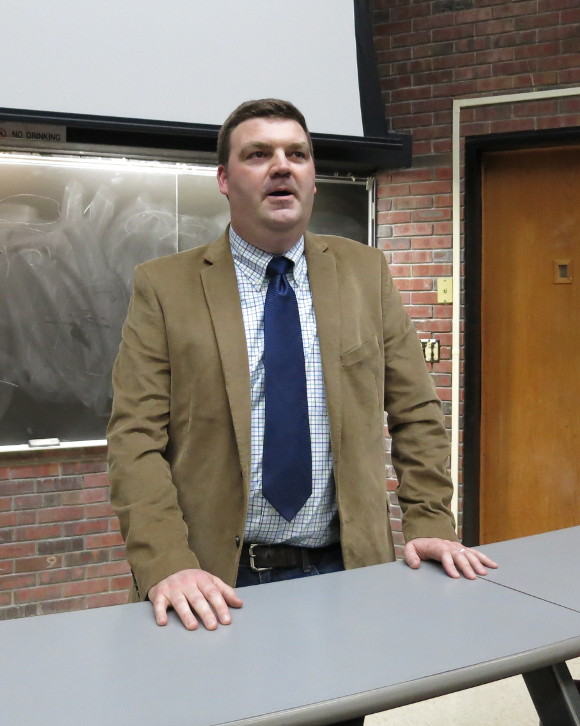 Hayden enlisted in the U.S. Navy his senior year at New Paltz and trained every bit a cryptologic technician and linguist. He completed 99 weeks of Arabic linguistic communication immersion at the Defence Language Establish in Monterey, California, and subsequently received additional grooming to become one of the Navy's first five Pashtu-Afghan linguists.
After six years in the Navy and a tour in Afghanistan, he enrolled in graduate school at the Fels Institute of Government at the University of Pennsylvania and earned a Master of Public Administration degree. Knowing that he wanted a career in public service, Hayden applied to Governor Andrew Cuomo's Empire Country Fellows Plan and was selected from over 950 applicants to join the first ix-person form.
The program sought to train mid-career professionals with advanced degrees working in the private or nonprofit sectors to presume senior management positions in the state government, building what Cuomo called a "back bench" of qualified staff ready to assume leadership roles upon current officials' retirement.
During his 2-year appointment, Hayden was paired with mentors from the Section of Labor and the Segmentation of Criminal Justice Services. He participated in several projects for the governor'southward office, including creating a brochure for the state'south Wine and Beer Summit, drafting a 310-page public policy book that included a push for an increase in the country'due south minimum wage, and helping to organize a veteran and military families superlative. "These were all unique experiences that a year before, I would've never seen coming," Hayden said. "Information technology was actually valuable."
Later developing skills in operation management during his work as an Empire Land Boyfriend, Hayden helped to transform the Palo Alto, California, hospital system for the U.S. Department of Veterans Diplomacy, working closely with the department's chief of prosthetics. "I knew absolutely zilch about prosthetics, but I knew by and large most process improvement and how to look at a multifariousness of unlike factors and piece them together. Being a former cryptologist and figuring out puzzles and solving issues were good general skills that I brought to that job," Hayden said.
Hayden drew upon the transferrable skills he learned at New Paltz, the Academy of Pennsylvania, and his prior piece of work experiences to land his current job as a program analyst with the U.S. Section of Housing and Urban Development (HUD). Hayden works in the Baltimore Office of Public and Indian Housing, which oversees 60 local public housing authorities. He monitors performance and conducts risk assessments for housing authorities throughout the Mid-Atlantic Region, which includes West Virginia and most of Maryland.
During the Q&A, Hayden told students that they should prepare for the vicissitudes of the job marketplace by condign expert at trouble solving, which he has demonstrated throughout his career. "Regardless of what the problem is … whether it's prosthetics or housing or workforce development, criminal justice, economic evolution, wine, beer, spirits, everything – if you lot tin put the pieces together in a fashion that makes sense to whomever yous work for and do information technology better than the other guy, that's the key," he said.
Hayden also advised students to accept advantage of internships and other experiential learning experiences similar the United Nations (Un) Semester and Harvard Model United nations to gain a greater understanding of the bug they will face up in the workforce and "kickoff thinking about them earlier [they] actually get to that position."
In an uncertain economy, Hayden said students must e'er be willing to learn new skills. He is pursuing his doctorate in public administration from the University of Baltimore in an endeavor to have the "near unimpeachable credentials" in his field while Congress mulls across-the-lath federal budget cuts, which will likely include staffing cuts.
"I want to make myself as recession-proof as I tin can," he said.
Hayden's talk was sponsored by the Section of Political Scientific discipline and International Relations and was one of several featured events of the Career Resource Heart's Public Service Week.
LA&Due south Alumni Share Career Success Stories
In her remarks at the Oct. thirteen "Classroom to Career: The Value of a Liberal Arts Caste" event, Higher of Liberal Arts and Sciences Dean Laura Barrett argued that flexibility of heed, and not narrow chore training, best equips students to enter the workforce.
Employers, said Barrett, "value habits of mind, constructive disquisitional thinking, articulate communication, intellectual curiosity, flexible and creative problem solving that liberal arts and sciences teach."
Empowering stu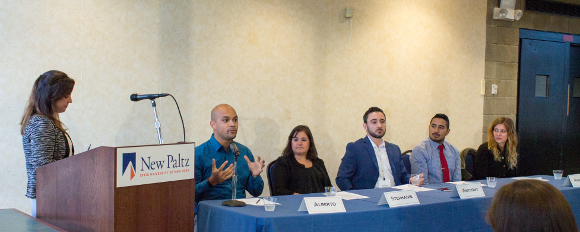 dents to recognize and clear the skills they've gained through the study of the liberal arts was a primary goal of the second-annual event, organized by Emily Zurner, Senior Career Specialist in the Career Resource Heart, in collaboration with the Higher of Liberal Arts and Sciences.
The five alumni panelists drew connections between their liberal arts educations and career successes, and provided advice and encouragement to students embarking on professional careers. Current graduate pupil Nicole St. Onge '16 (Communication Studies – Public Relations) moderated the panel, which was followed by an audience Q&A and networking reception.
Alberto Aquino '12 (Political Science) said studying political science allowed him to gain a greater insight into social issues like poverty, racial injustice and income inequality, and strengthened his desire to help others every bit an educator. Aquino became certified equally a math teacher though Teach for America and is now director of the Armory College Prep Middle Schoolhouse Program in New York Metropolis.
"When I look dorsum to the past, what I was really looking for at that time was to help people in any way I could, whether it was through educational activity or whatever not-turn a profit work, and I think my political science groundwork gave me sense of which management to go towards," he said.
Stephanie Adika '07 (Women'due south Studies), events manager at the Simons Foundation in New York City, has worked with diverse partners throughout her career. She credited her women's studies and political science coursework with helping her to communicate with others around the earth while beingness mindful of cultural differences. "I could be on the phone with someone in an Arab nation and a couple hours subsequently, on the telephone with someone in Mexico. Understanding the multicultural aspect of the world, which you can really go from a liberal arts degree, to me is one of the well-nigh important things that I learned," she said.
Angelica Snyder '08 (Sociology – Criminology Concentration) works as a prospect researcher at SUNY New Paltz and utilizes the communication and analysis skills she learned equally an undergraduate. She noted that writing papers provides students with essential workforce preparation. "You have to brand a instance when you write, it has to be cogent, information technology has to be succinct and a lot of times you lot take to convince somebody of something, and that's really important," she said. "Existence able to express yourself to get your point across, I retrieve that's one of the nearly valuable things I learned hither, and information technology keeps on giving. I apply it every twenty-four hours," she said.
The panel's virtually recent graduate, Joshua Galow 'xvi (Anthropology), landed a job as the Vice President of Delegate Date at Skytop Strategies in New Paltz by attending an on-campus career fair. He researched the company, asked relevant questions and drew upon his ain studies of anthropology and sociology to connect his piece of work to the company'south mission. Galow advised students to convey to potential employers "what value you lot can bring to an system based on what your passion is and what you're learning hither at the schoolhouse."
Anthony Church building '07 (Psychology), '13g (MBA) described his college career as a "journey" that immune him to follow his varied interests in psychology, international relations, philosophy and other disciplines. Church building, the Vice President of Operations at Collaborate Marketing in New Windsor, said his ability to connect with others and think critically have served him well in life and business organization.
Church building echoed Dean Barrett by proverb that narrow, professional preparation isn't appropriate for nearly jobs. "Sometimes those in the liberal arts programme are concerned or have some anxiety that they are maybe learning things that aren't going to exist directly applicable to a job," he said. "Nigh jobs that are out in that location don't take a specific degree associated with them. You tin can't do a better job of preparing yourself for those jobs than you tin past exposing yourself to the concepts that you go through a liberal arts degree."
Learn more than about offerings available at the Career Resources Center by visiting the center's website.
LA&S Alumni Render to Talk Careers with Current Students
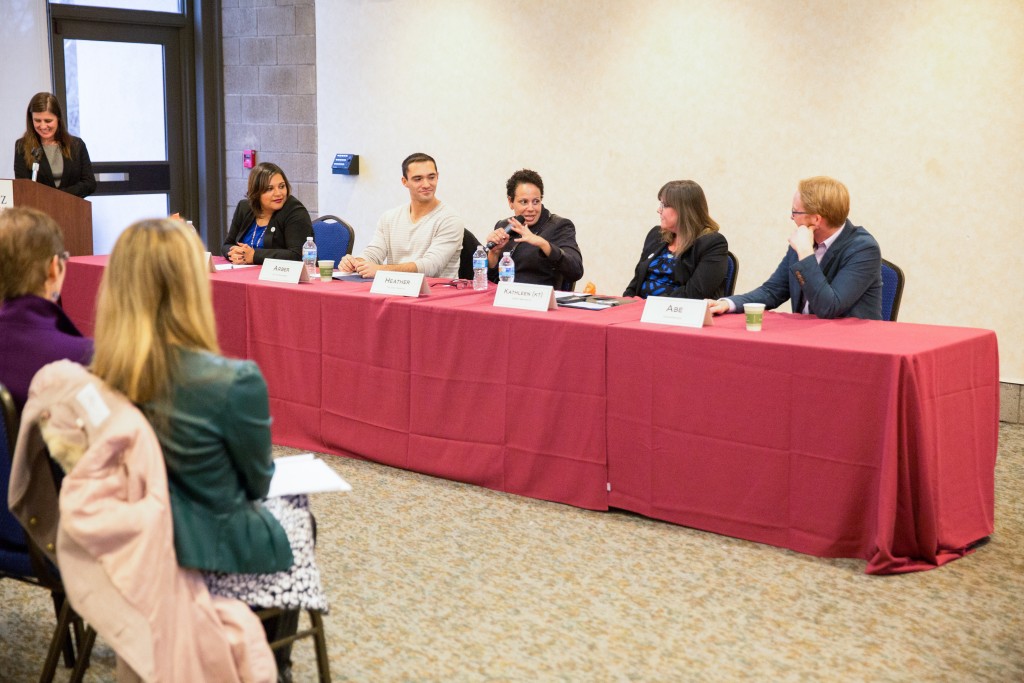 "We know that today'southward graduates are likely to have several jobs before they retire," said Laura Barrett, dean of the College of Liberal Arts & Sciences at SUNY New Paltz. "Job satisfaction requires a sense that we're doing something meaningful, and providing a service to lodge. Degrees in the liberal arts not only open up a broad array of career opportunities; they prod united states of america to challenge ourselves and keep to grow."
And so began a recent panel give-and-take, "Classroom to Career: The Value of a Liberal Arts Caste," featuring five alumni of the College of Liberal Arts & Sciences. Each speaker represented a different major and a different career path, merely all agreed that their degrees, and the educations they stand for, have proven tremendously valuable in both their professional lives and in their personal and intellectual growth.
"When people would ask me, 'What are you lot going to do with that degree?' I felt confident in answering, 'I tin can do whatever I want with information technology,'" said Claudette Aldebot '06 (Castilian), a Marketing and Recruiting Director at New York Life.
Arber Cobaj 'fifteen (Philosophy), Director of Program Development at Skytop Strategies, contributed a perspective drawn from his experience every bit a central member of a Hudson Valley showtime-up.
"No matter how well-run a visitor is, when it is this young there are going to exist roles and activities that are undefined or non quite understood," Cobaj said. "The flexibility of listen that I developed every bit a philosophy major helps me to stride into these roles and conceptualize ways I might be able to contribute. From day one at this visitor, my role has been to build a role for myself. Thanks to my enquiry background, that feels like a beautiful spot to exist in."
Other panelists counseled student attendees to trust and rely on the skills they proceeds as liberal arts majors when it comes time to seek employment.
"I tell my students all the time, if yous acquire one thing in college, make sure y'all learn how to communicate, both via the written and the spoken discussion," said KT Tobin '92 (Folklore), Associate Director of The Benjamin Middle. "Effective communication transcends any specialized or substantive noesis. It doesn't matter what kind of company y'all're working for – employers are going to want someone who can get up and speak on that company'south behalf."
"It took me a long fourth dimension to learn how important it is to do your own research when you are preparing to join the workforce," said Heather Graham '97 (Black Studies), Digital Director at the Daily Gazette. "Researching the visitor you are going to interview dramatically increases the odds that you'll exist invited dorsum. Realizing that made me much more confident, because equally a liberal arts major learning how to inquiry well and research efficiently was a big function of my instruction."
"Classroom to Career: The Value of a Liberal Arts Degree" was organized and hosted through a joint endeavor of the College of Liberal Arts & Sciences and Emily Zurner, Senior Career Specialist in the Career Resource Eye.
Source: https://www.newpaltz.edu/lasalumni/news.html
0 Response to "The Liberal Arts Are the Skills Habits and Values of Entrepreneurship"
Post a Comment